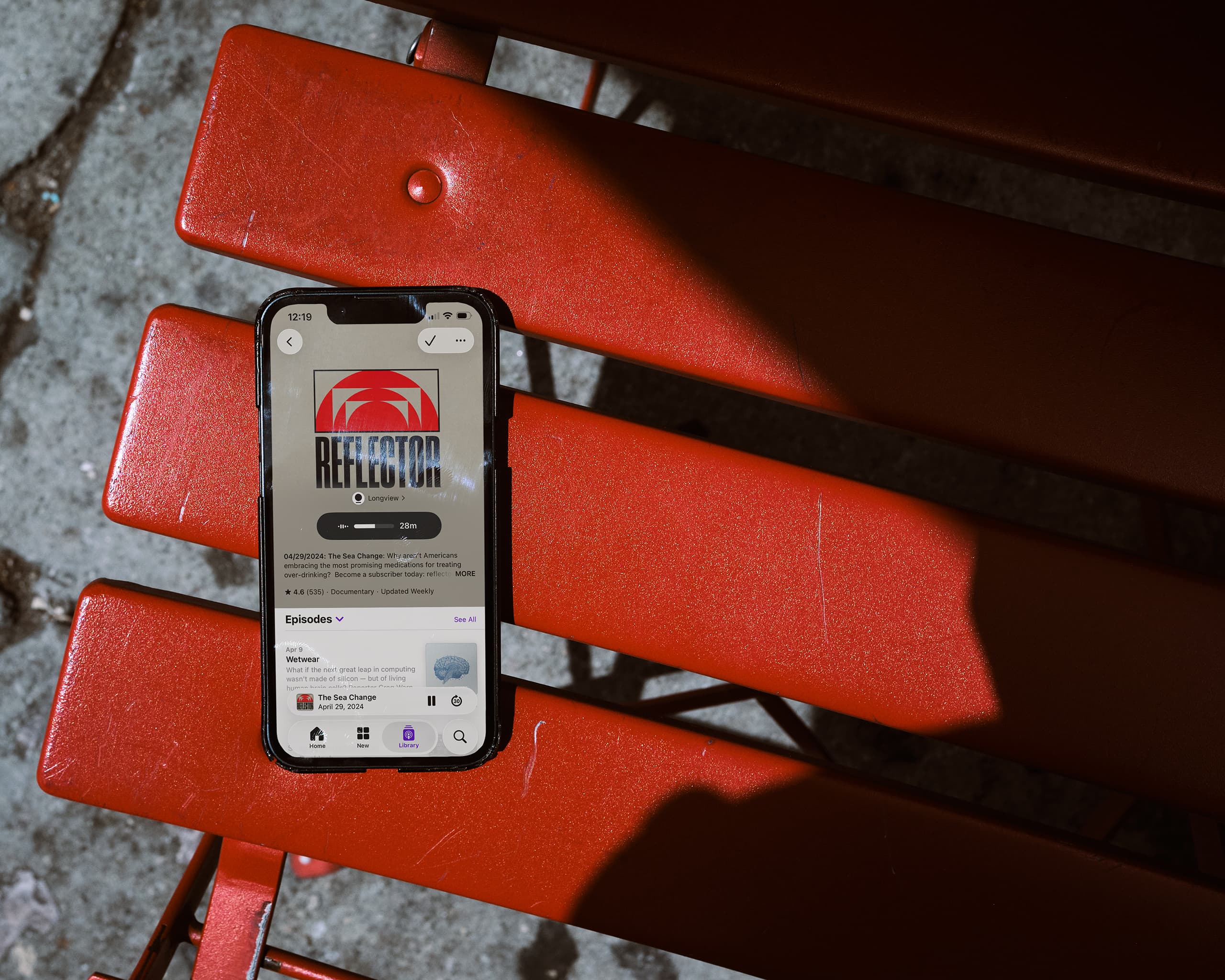

Welcome, all, to the third and final installment of Strange Bedfellows. Judging from all the positive feedback we’ve gotten, it looks like Reflector listeners have thoroughly enjoyed this homosexual experience.
We start today’s episode with an object lesson in how queerness (often cited as the “Q” in LGBTQ) has not only become the dominant ethos of “LGBTQ,” but has also significantly altered the way the general population talks about and comprehends the world around them.
You may be thinking, Am I about to listen to a chorus of people bellyaching about pronouns in email signatures?
Relax, we cut that hour from the program. This episode centers on a far more exciting topic: sex!
Well, sex education. (Sorry.)
If you don’t have kids, you may not be aware of what sex ed is like these days. If you do, you can check your eight-year-old’s progress by asking her to find the clitoris.
Our reporting uncovered that the lesson plan above – taken from a free online curriculum called Rights, Respect, Responsibility – is currently in use at a Chicago-area elementary school. The “3Rs” curriculum, which has also been officially adopted by the San Diego Unified School District, was released in conjunction with the National Sex Education Standards – a rather ingeniously-titled document published by a group of organizations collectively called The Future of Sex Education.
There are in fact no official “national” sex education standards; standards are generally set by the state. But the National Sex Education Standards are followed by NYC Public Schools and the Illinois Board of Education. Oregon’s sex-ed curriculum is “closely aligned” with the NSES, and the governments of Connecticut, Colorado, Maine, New Jersey, New Mexico, Vermont, and Wisconsin all cite the Standards as an authority on sex ed. Other progressive states, like California and Washington, use comparable sex-ed curricula.
And the NSES are brimming with queerness. The Standards require that by the end of second grade kids be able to “define gender, gender identity, and gender-role stereotypes,” a way of conceptualizing gender that suggests to children that each one of them might be a boy, a girl or something totally different, depending on their feelings.
According to the Standard’s glossary, gender refers not to the state of being either male or female, but rather to “a set of cultural identities, expressions, and roles.” While “typically attached to a person’s sex assigned at birth and codified as feminine or masculine,” the Standards explain, gender “is socially constructed, and it is, therefore, possible to reject or modify the assignment made and develop something that feels truer to oneself.”
For many people, this definition might be satisfying. Others argue that it is circular; indeed, it’s very difficult to define gender without reference to biological sex (try it!). Still others doubt the usefulness of gender as an analytic framework; as one advocate once said to me, “there are two genders and there are infinite personalities.”
Importantly, the Standards and the “3 Rs” curriculum do not introduce their understanding of gender as merely one possible way to make sense of the world, but as the only way to make sense of the world. (See for example this seventh grade lesson, which establishes as a “fact” that a male can feel on the inside that he is a girl. That’s true enough, but how does the curriculum define “girl”? It doesn’t.)
The Standards recommend benchmarks for students like: by the end of fifth grade, kids should be able to “define and explain differences between cisgender, transgender, gender nonbinary, gender expansive, and [a]gender identity.” By the end of middle school, they should be comfortable explaining “a range of identities related to sexual orientation (e.g., heterosexual, bisexual, lesbian, gay, queer, two-spirit, asexual, pansexual).”
It may also be surprising to parents of young people across the country that these standards presume as accepted fact that sex is not a biological reality, but rather a category “assigned at birth.” The curriculum also advises teachers to swap out “male” and “female” whenever possible for “people with penises” and “people with uteruses.”
No matter what you believe personally about the validity of these queer theory–inspired ideas, they remain fringe to many in the American public. This is despite the fact (as we covered in our last episode) that they’ve quickly been woven into corporate HR handbooks and state and federal laws.
Unsurprisingly, they’ve contributed to a national backlash.
The sex ed curricula promoted by advocacy groups have been met with resistance from parents from Wisconsin to Virginia. Of course, parents being upset about what their kids are taught in sex ed is a tradition as American as political spats on Thanksgiving. But these particular parental concerns about sex ed – which broadly began during the learn-from-home era of Covid school closures – aligned with growing frustrations about exactly how far many schools were going in promoting LGBTQ-related content and enacting policies that privileged gender identity over physical sex. There have been, for instance, multiple dust-ups over the availability of books like Gender Queer and All Boys Aren’t Blue at school libraries. The inclusion (or exclusion) of trans girls on girls’ sports teams has led to lawsuits in Minnesota, Idaho, Connecticut, California, and elsewhere. And of course, the highest-profile debate has been around the availability of medical treatments for gender-nonconforming youth.
All of these developments have fed the reversal of what many advocates once felt was the inevitable march of progress. President Trump has removed “gender identity” from government documents, and imposed a requirement that all government identification be labeled with biological sex. Medical bodies have begun to recognize the lack of robust evidence that medical intervention for gender-nonconforming minors is beneficial. Last year, the Supreme Court upheld Tennessee’s ban on youth gender medicine. What began as a vibe shift has become realized in policy.
We started off this series in the middle of the 20th century, when being gay was not only illegal, but seen by the public as both evil and icky. According to the Roper Center for Public Opinion Research, 70% of Americans in 1965 said homosexuals were “harmful to American life.” Three out of four of them believed homosexual acts should be kept illegal. By 2021, those numbers had flipped: 70% of Americans told Gallup: “Homo? No problemo!” And for the first time, gay marriage was acceptable by majorities in both political parties. In 2022, large majorities in both parties supported anti-discrimination protection for LGBTQ people.
But in the past few years, trends have begun to reverse. Yes, the majority of Americans still support gay rights and oppose anti-LGBT discrimination. And there has been a massive boom in how many people self-identify as being a part of the coalition (from just 3.5% in 2012 to 9.3% in 2024). But a growing number of people across the political spectrum are uneasy about the goals of the broader coalition – particularly when it comes to allowing males to compete in women’s sports and giving minors medical treatments that arrest their sexual development.
And this all raises the question: How will the LGBTQ movement, if it still is a movement, meet this moment?
Our final episode presents a number of different perspectives that we think you’ll find insightful, surprising, and revealing.
On one end of the spectrum are those who think sexual orientation and gender concerns are fundamentally incompatible causes – that the time has come to sever LGB from TQ+. Others feel that these identity groups are still united by their shared bucking of gender norms, and that the solution to the current backlash is for us to treat one another more collegially, and engage with skeptics in good faith debates. (Only one of my interview subjects, the gender theorist Susan Stryker, expressed comfort with rejecting communication with critics.)
The most notable change came from former GLAAD president Herndon Graddick, who played an active role in GLAAD’s shifting focus from gay rights to trans rights. He campaigned in particular for trans girls’ participation in girls’ sports and the inclusion of trans women in the Miss Universe competition. In 2013, he honored 12-year-old Jazz Jennings and 6-year-old Coy Mathis – both of whom are natal boys who identified as girls, lauding their heroic bravery. He now thinks it was a mistake to so uncritically celebrate Jennings and Mathis, and that the movement badly needs to change course.
“We need to correct what’s wrong,” he told me, “particularly the medicalization of children.”
To my knowledge, this is the first time a leader or former leader of a major LGBT organization has publicly retreated on any trans-related positions previously endorsed. He continued: “I just think that we should completely stop doing anything that might harm children, even if it admits that we’ve gotten something really wrong. And my understanding is that we have.”
In episode 1, Andy asked me why I wanted to do this podcast. I only gave him half the answer. Yes, I wanted to understand how “LGBTQ+” came to be a political force, and how it so successfully normalized a way of thinking about gender that would have been utterly foreign to nearly all Americans not 15 years ago.
But I also wanted to report this story out of frustration with the way media—particularly LGBT-aligned media—have presented the current backlash as fundamentally repressive, illiberal, hateful, and/or religiously motivated. On some level, it’s hard to blame them: the people who most vocally oppose the current movement are from the same party that more vociferously opposed gay rights. But what I hoped to show is that today’s project that goes by LGBTQ raises difficult questions about sex, identity, and whose rights ought to take precedence when these two categories collide. For some time, activists have insisted that even grappling with these questions is an act of bigotry—so of course no one who wishes to remain in good standing with liberal people is going to touch this stuff. This is a topic reserved for only the most self-destructive egomaniacs among us. And so here we are.
I’ve tried to present the viewpoints of my subjects in language that’s as neutral as possible – except, of course, when in the service of a good joke, as some things are sacred. But by now you’ve probably sussed out some of my feelings, and perhaps you are wondering just whose side I’m on.
When I spoke with some of the people behind the sex ed curriculum that’s been a part of this recent backlash, one of the most interesting interviews was with Dr. Eva Goldfarb, who teaches public health at Montclair State University. I asked her why it wouldn’t be wiser to teach the fact of biological sex distinctions (which is especially important when teaching kids: What is sex?) – even if you were also introducing them to the social norms associated with gender. As a result, we got into a debate about whether there are even objective, universal facts at all.
I found myself in a similar debate when I interviewed the queer theorist Dr. Susan Stryker. For people aligned with this school of thought, the things we think of as “true” are merely reflections of the way people understand the world in a particular time and place. Pointing to the diversity of human belief systems, this camp finds no reason to award any greater “truth value” to ideas grounded in science, logic, or reason.
And I must confess: I disagree. I see this line of thinking as a sort of parlor trick: Take the mundane observation that our understanding of the world depends on when and where we are in it, and argue that therefore nothing is knowable. How many academic careers, I wonder, have come out of this game?
I’d like to posit that socially liberal people like me, and those closest to me, do not in fact embrace the tenets of queer theory. I would bet that most of us regard biological sex as a fact of life, not a product of history – and that few of us believe there are no objective truths about reality. I also have the strange conviction that if most of the people I love – people who are sex-positive, open-minded, and instinctually inclusive – were to peruse the curriculum I spend much of this episode examining, they would find it as scientifically compelling as creationism.
And yet we are so siloed by the tools we use to make sense of the world – from each according to his biases, to each according to his algorithm – that the most vocal opponents of queerness (many of them gay!) have somehow found themselves aligned with the same folks who once opposed their civil rights.
Strange bedfellows, indeed.
*This article originally stated that "curricula are set by the state," but that has been changed to "standards are generally set by the state" to be more accurate. We apologize for the error.